AI FAQs
Last updated: August 29, 2026
Maze doesn't build or train its own AI models. Instead, we partner with leading AI providers to power our intelligent features.
This document outlines how we use AI to enhance user experience, the measures we take to ensure data security and privacy, and provides answers to common questions regarding our AI functionalities, data handling practices, and compliance with data protection regulations.
Performance and limitations
Intended use cases for Maze AI features
Building unmoderated studies
Rephrase research questions
Generate follow-up questions for testers
Summarize themes in responses
Transcribe interviews
Summarize transcripts
Highlight key points in transcripts
Group highlights into thematic summaries
External factors that may impact performance
AI models used by Maze process only text and speech (no image or video inputs).
Known caveats and recommendations
Outputs should be treated as suggestions, not definitive answers.
Users retain control over outputs and can accept or reject AI-generated suggestions.
Data handling and privacy
What data elements are being consumed by MazeAI’s GenAI capabilities?
Refer to Maze’s AI and Privacy for detailed information.
Do you utilize data uploaded or generated during AI usage for training or fine-tuning?
No, Maze does not use customer data for training AI models.
What actual data is sent to OpenAI’s services during AI functionality usage?
Maze never sends PII data in AI prompts, unless the participant responses contain such data.
For dynamic follow-ups, block titles and customer interactions are included.
In moderated features, transcripts may contain PII.
AI Model Usage and Functionality
What are the primary models and their sources in your product?
OpenAI's GPT range, accessed via OpenAI's developer platform and Anthropic's Sonnet/Opus range, accessed via AWS Bedrock
Deepgram's Automatic Speech Recognition (ASR) for voice-to-text transcription for AI Moderated studies, Moderated studies, and Unmoderated studies.
Which AI models/providers does Maze use?
The AI features at Maze fall under two categories, each powered by specialized third-party providers:
1) Features powered by Large Language Models (LLMs) for intelligent data processing and conversation, including AI-moderated studies, Open Question Follow-ups, AI Themes, and Suggested Highlights.
These features utilize OpenAI and Anthropic LLMs. To access Anthropic models, we use Bedrock. To test, deploy, and monitor the performance of the features, we use Google Gemini.
2) Features powered by Deepgram's automatic speech recognition (ASR) for voice-to-text transcriptions. This is used when transcribing interviews in AI-moderated and Interview studies. Features powered by Deepgram's speech to text processing. This is used when transcribing Clips in unmoderated studies.
What types of events and activities are logged by the AI features?
For more information, see this link.
How does generative AI work within your product, and are there other types of AI involved?
Generative AI (OpenAI’s LLMs):
Used for features like rephrasing research questions, generating follow-up questions, highlighting interesting points in interview transcripts, and identifying common themes.
Most features are user-facing and triggered manually by Maze users, allowing them to edit or delete AI outputs.
Participant-facing AI is limited to follow-up questions in open-ended surveys, which users can report if needed.
All AI outputs are explicitly indicated as AI-generated.
Automatic Speech Recognition (Deepgram):
Limited to transcribing video/audio recordings to text, which can be manually processed or analyzed with other AI features.
Does Maze identify content generated by MazeAI?
Yes, interactions with GenAI are clearly marked with a UI element to signal when users are interacting with AI services.


Data retention and compliance
Where is data hosted?
For more information, see our Data Processing Addendum.
What is the data retention policy for AI-related data?
OpenAI and Deepgram retain data for 30 days.
Google Gemini retains data for 55 days by default. Updates on retention periods will be reflected in our privacy documentation.
What is your contractual relationship with OpenAI and Deepgram?
Maze has established vendor agreements, including industry-standard service and data processing terms. These agreements align with SOC2 framework requirements and are detailed in our Vendor Management Program.
For more information, see our Data Processing Addendum.
Security and architecture
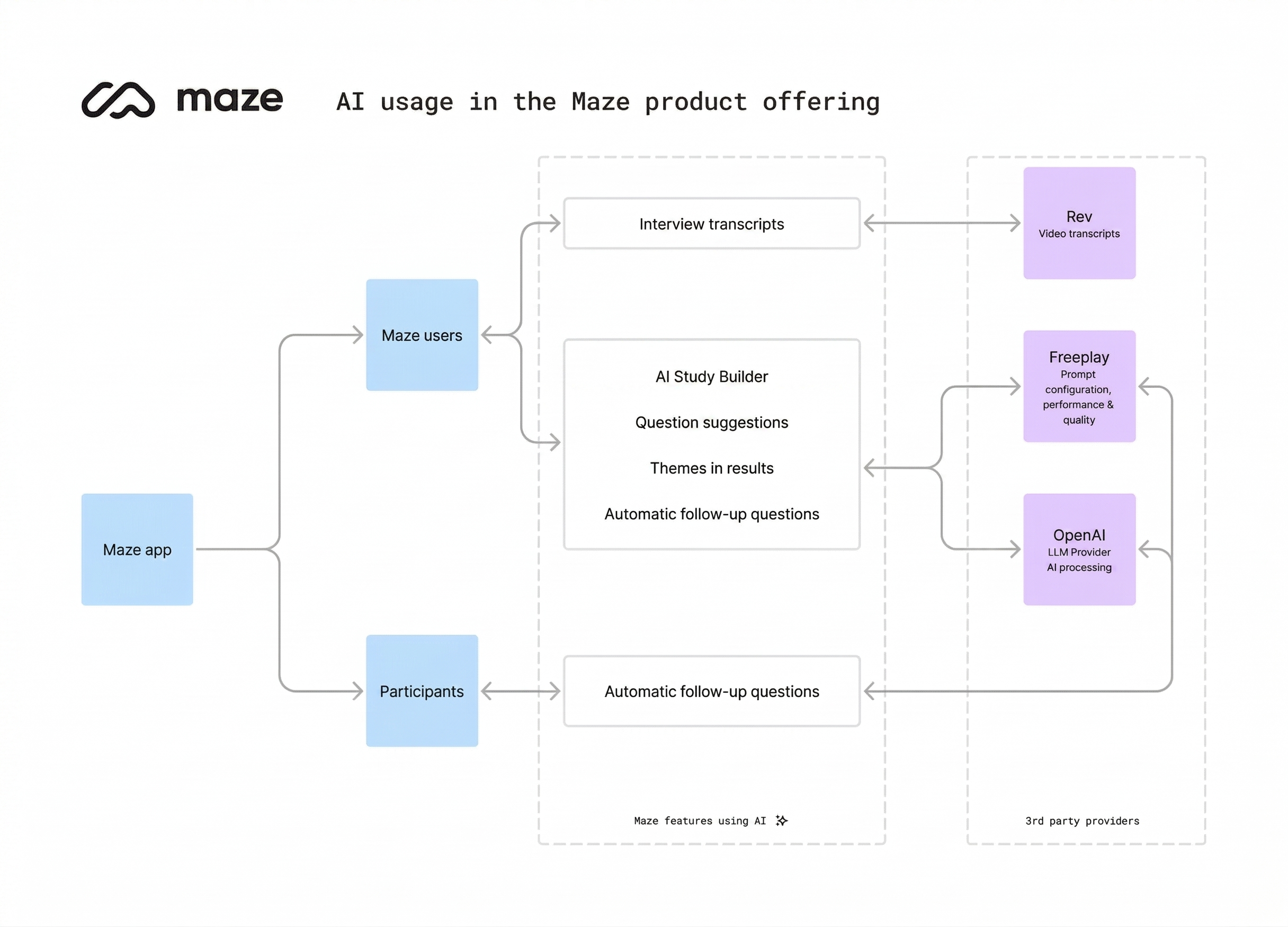
Can you provide an architectural or data flow diagram?
A high-level network diagram is available on our Compliance Resources page.
Evaluation metrics
Are there documented performance metrics for the models?
Maze does not train its own models, so evaluation metrics (e.g., accuracy, recall) are not available.
OpenAI may have performance metrics, but they are not publicly shared.
Contact information
How can users reach out for AI-related concerns?
For sub-processor contact information, refer to Maze’s Data Processing Addendum.
For direct inquiries, contact Privacy@maze.design